
MICROCAST: Advancing Localized Weather Forecasting with Julia and Scientific Machine Learning
- Environmental Forecasting
- Company News
Modern global weather models provide essential large-scale forecasts but cannot fully resolve localized conditions that affect maritime and aviation operations. Coastal winds, harbor fog, terrain-driven turbulence, and atmospheric boundary-layer dynamics often occur at scales smaller than global forecasting grids.
Operational global models compute on grids roughly 10 to 25 kilometers across. The Navy is asking for forecasts at less than 1 kilometer horizontally and about 10 meters vertically in the boundary layer.
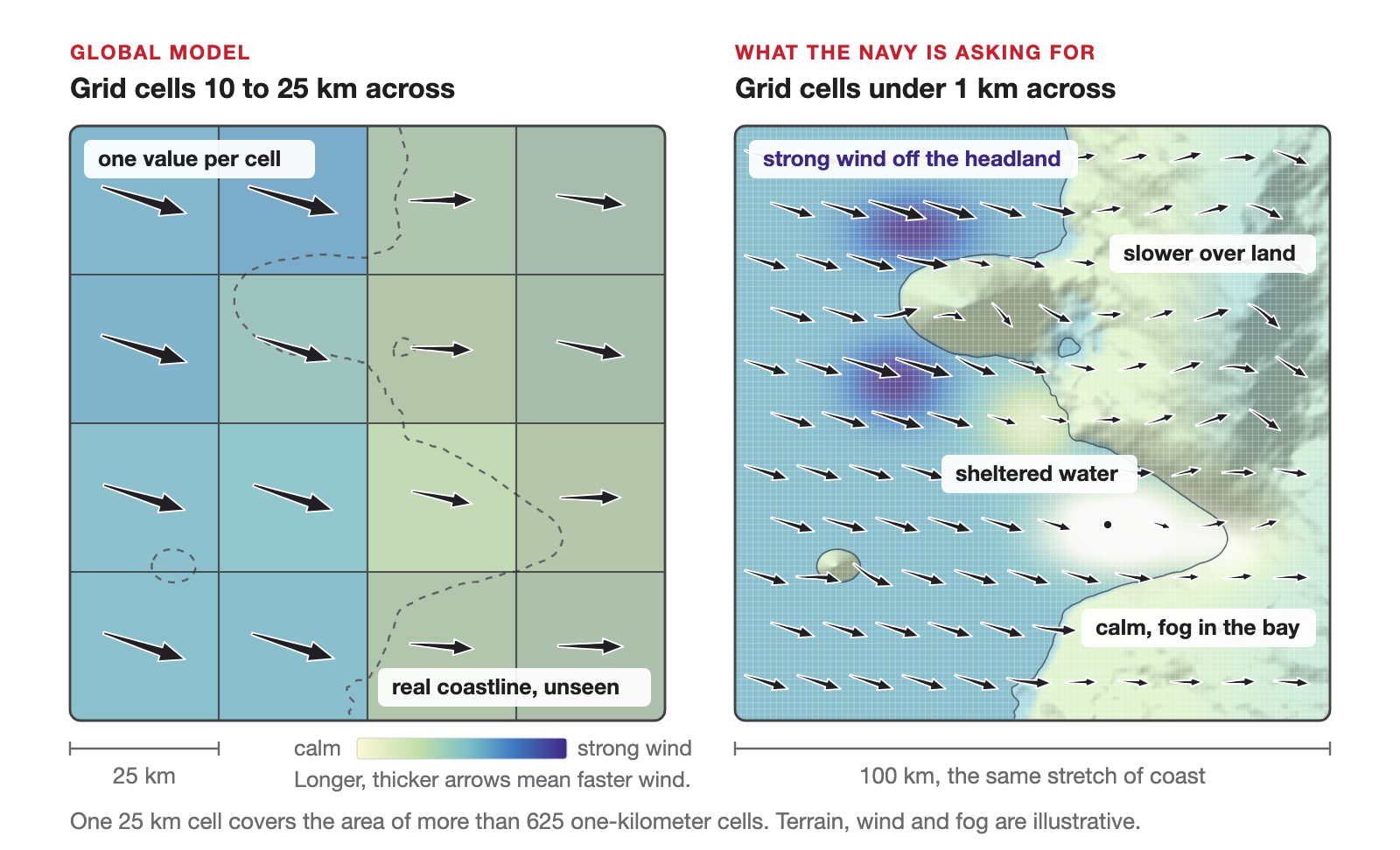
MICROCAST addresses this gap by developing a framework for near real-time forecasting at that scale, updating every 5 to 15 minutes.
The Navy’s Challenge
MICROCAST was selected under Navy SBIR topic N252-105, Machine Learning Downscaling Capability for Environmental Forecasts, sponsored through the Office of Naval Research.
The objective is to translate coarse-resolution environmental forecasts into more detailed local predictions without the computational expense of running high-resolution numerical simulations everywhere.
Traditional approaches present a trade-off:
- High-fidelity physics captures complex local dynamics, but halving the grid spacing raises compute cost roughly sixteenfold.
- Data-driven machine learning provides rapid predictions but can produce plausible but unphysical fields outside its training conditions, and small-scale observations to check them are scarce.
MICROCAST offers both routes. Dynamical downscaling nests a high-resolution physics model inside the coarse forecast and computes the local weather directly. Machine learning downscaling uses a surrogate trained on those simulations to produce fine-scale fields in a fraction of the time. The method can be matched to the mission.
A Composable Physics and Machine Learning Framework
MICROCAST integrates three complementary capabilities:
- Global atmospheric modeling, using a spectral model to supply initial and boundary conditions.
- High-resolution physics simulation, using large eddy simulation to resolve turbulence directly.
- Scientific machine learning to build fast surrogate models from those simulations.
Building on Open-Source Julia Climate Technologies
A central advantage of MICROCAST is its foundation in the international Julia climate and scientific computing community.
The framework draws on four open-source technologies:
- SpeedyWeather.jl: Fast spectral global atmospheric modeling.
- Oceananigans.jl: GPU-accelerated ocean and fluid dynamics simulation, including large eddy simulation.
- NumericalEarth.jl: Coupled atmosphere, ocean, sea ice, and land simulation, built on Oceananigans.
- Reactant.jl: Compiles Julia through the MLIR compiler framework to run on CPUs and GPUs, with Enzyme for automatic differentiation.
Julia’s composability enables physics models, numerical solvers, and machine learning components to operate within a shared software environment. Because every layer is Julia, the design goal is a pipeline differentiable end to end, so machine learning components can be trained inside the physics solver instead of bolted on afterward.
Rallypoint One’s role is to integrate and extend these foundations into an operationally relevant forecasting capability while contributing improvements back to the community where possible.
Extending the Approach to Wildfire Resilience
The same scientific computing strategy supports Rallypoint One’s wildfire modeling work with the NSF ASCEND Engine, led by Innosphere.
As a technical coordinator and integration partner for the Asset Resilience through Intelligent Digital Twins (ARID) program, Rallypoint One supports efforts to improve wildfire risk assessment for power and water utilities in Colorado and Wyoming.
Our HEATMAPS framework uses Julia-based physics simulations to train computationally efficient surrogate models of wildfire propagation.
MICROCAST and HEATMAPS are independently sponsored programs addressing distinct operational challenges. Both demonstrate the potential of combining physics-based modeling, scientific machine learning, and composable open-source software to accelerate environmental predictions.
Additional background is available in our wildfire modeling survey and catalog of wildfire simulation models.
Acknowledgments
Rallypoint One gratefully acknowledges the support of the Office of Naval Research and the Navy SBIR program, along with the researchers and developers advancing the open-source Julia ecosystem.
We look forward to sharing technical progress as MICROCAST advances.