HEATMAPS: Accelerating Wildfire Prediction with Julia and Scientific Machine Learning
- Wildfire
- Company News
Wildfire models face a persistent trade-off between speed and fidelity. The tools fast enough for operational use simplify the physics, and the models that capture the physics are too slow to run the many scenarios that planners and responders need. Coupled fire-atmosphere models can need hours of supercomputer time to forecast a few hours of fire. Wind, terrain, fuels, and fuel moisture interact at fine scales, and conditions can change faster than a detailed simulation can keep up.
HEATMAPS addresses this gap by developing an open framework for faster-than-real-time wildfire propagation modeling.
The Wildfire Challenge
HEATMAPS (High-Efficiency AI Twins for Modeling and Prediction via Surrogates) grew out of wildfire research supported by the NSF ASCEND Engine, a National Science Foundation Regional Innovation Engine led by Innosphere that connects Colorado and Wyoming’s federal laboratories, research universities, and technology companies.
The Engine’s Asset Resilience through Intelligent Digital Twins (ARID) program is building a shared simulation platform to help power and water utilities anticipate and manage growing wildfire risk. Rallypoint One serves as a technical coordinator and integration partner for ARID.
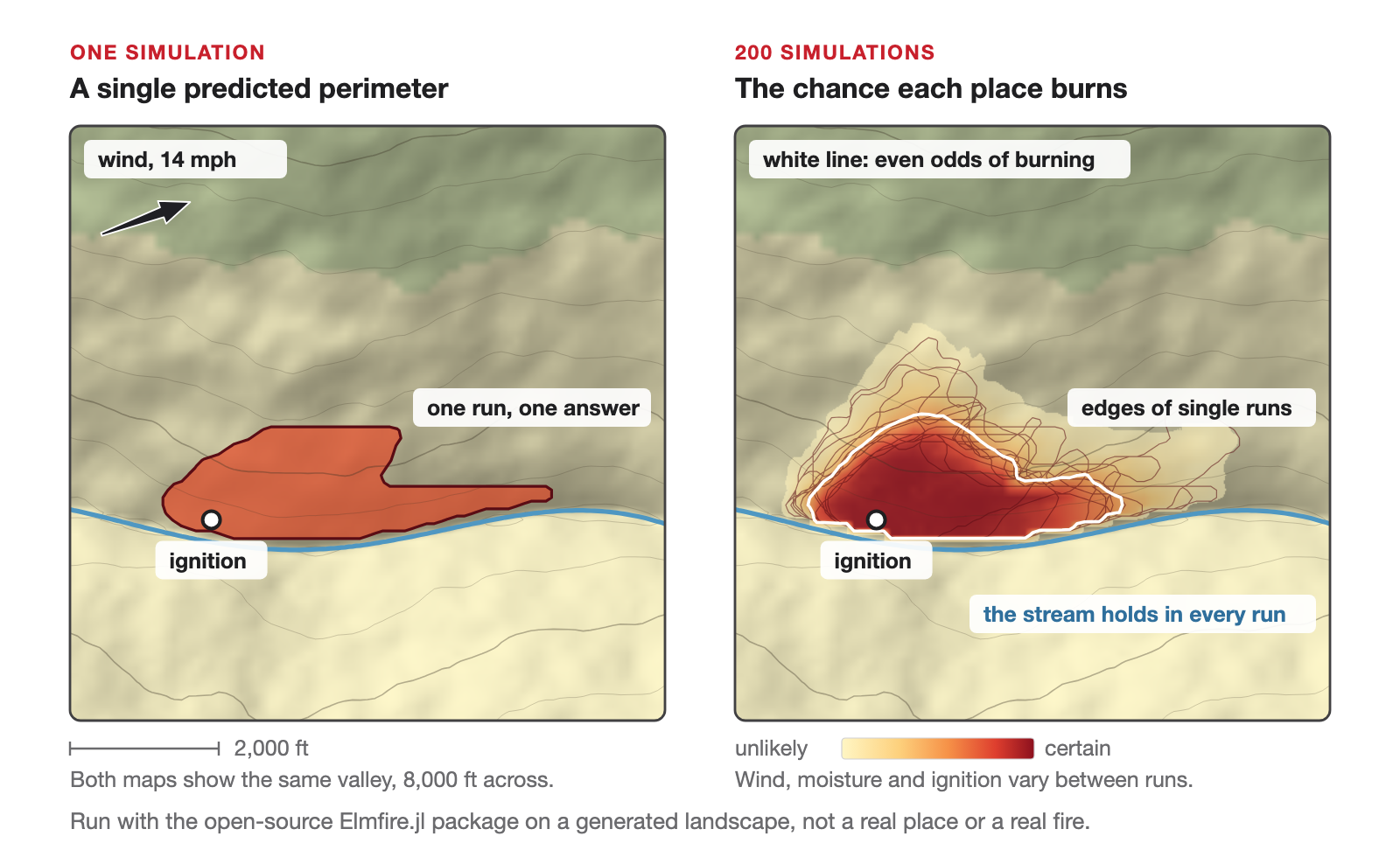
The objective is to give decision-makers physically grounded fire predictions quickly enough, and in large enough numbers, to compare scenarios and understand uncertainty: ensembles of runs that produce burn probability maps instead of a single predicted perimeter.
Traditional approaches present a trade-off:
- Empirical and semi-empirical models, such as the Rothermel-based tools used operationally, are fast and widely used but simplify fire behavior under extreme conditions.
- High-fidelity physics and coupled fire-atmosphere models, such as WRF-Fire, capture richer dynamics but require substantial computational resources.
HEATMAPS seeks to combine the strengths of both approaches, preserving the physical foundations of fire modeling while accelerating the generation of predictions.
A Framework for Wildfire Surrogates
HEATMAPS integrates three complementary capabilities:
- Physics-based fire propagation modeling, using the Rothermel surface spread model and a level set method to track the fire front, with crown fire and ember spotting.
- Scientific machine learning, using physics-informed neural networks to build fast surrogate models from those computations.
- A reusable model library with 2D and 3D visualization and sensitivity analysis, designed for GPU, edge, and mobile use.
Building on Open-Source Julia
Like our other programs, HEATMAPS is built in Julia and on the open-source scientific machine learning ecosystem that the Julia community maintains.
Rallypoint One has released the following packages as open source:
- Wildfires.jl: Rothermel fire spread and level set front propagation, with GPU support.
- Elmfire.jl: A Julia implementation of the ELMFIRE fire propagation model, including crown fire, ember spotting, and Monte Carlo ensembles.
- Landfire.jl, WildfireData.jl, and RapidRefreshData.jl: Access to public fuels, wildfire, and weather data.
- GeoSurrogates.jl: Neural network representations of terrain and wind fields that can be evaluated at any resolution.
HEATMAPS also draws on Reactant.jl, the community compiler technology that MICROCAST uses. Reactant.jl compiles Julia code for high-performance execution across computing architectures. Applied to wildfire simulation code, it accelerates the same model toward faster-than-real-time performance and allows it to be deployed to edge computing devices without being rewritten for each platform.
Julia’s composability enables fire models, data pipelines, and machine learning components to operate within a shared software environment.
Rallypoint One’s role is to integrate and extend these foundations into tools that utilities and their partners can evaluate against real operational needs.
Connecting Wildfire and Localized Weather
Fire behavior depends heavily on local weather, and wind above all. Our wildfire modeling survey identifies machine learning weather downscaling to fire-relevant resolutions as a priority for the field.
That is the problem Rallypoint One addresses for the Navy under MICROCAST, which applies the same scientific computing strategy to localized environmental forecasting.
HEATMAPS and MICROCAST are independently sponsored programs addressing distinct operational challenges. Both demonstrate the potential of combining physics-based modeling, scientific machine learning, and composable open-source software to accelerate environmental predictions.
Additional background is available in our wildfire modeling survey and catalog of wildfire simulation models.
Acknowledgments
Rallypoint One gratefully acknowledges the support of the NSF ASCEND Engine and Innosphere, along with our ARID program partners and the researchers and developers advancing the open-source Julia ecosystem.
We look forward to sharing technical progress as HEATMAPS advances.