IRAM: Hybrid Digital Twins for Metal Additive Manufacturing
- Additive Manufacturing
- Company News
Metal additive manufacturing builds components layer by layer through rapid melting and solidification. Defects can develop within fractions of a second, yet often remain undetected until post-build inspection.
The underlying cause is thermal history: the sequence of heating, cooling, and reheating that each region of a part experiences. Thermal history governs whether layers fuse, what structure the metal takes, and how much stress is left in the part. It is also a moving target. As a part grows, its changing geometry and accumulated heat alter how it responds to the same machine settings, so settings that worked early in a build can produce porosity or lack of fusion later.
IRAM aims to close this gap through a hybrid digital twin that connects computational models with sensor measurements to predict defects as manufacturing progresses.
NASA’s Challenge
IRAM was selected under the NASA SBIR Ignite program, 2025 subtopic I01.01, Advanced Real-Time Monitoring and Control Technologies for Additive Manufacturing.
NASA is advancing additive manufacturing for propulsion, spacecraft, and future in-space manufacturing applications. These systems require improved process monitoring and greater confidence in the quality of manufactured components.
Traditional modeling approaches involve a trade-off. High-fidelity simulations capture the underlying physics but are computationally expensive. Machine learning enables rapid predictions but may be less reliable outside its training conditions.
IRAM combines both approaches to deliver faster predictions grounded in physical models.
A Hybrid Digital Twin Framework
IRAM is a computational model of the growing part that combines heat-flow physics with models learned from build and inspection data. It integrates three complementary capabilities:
- A part-scale thermal model. Physics-based modeling of heat input, conduction, and phase change predicts the thermal history of every region of the part. The model is differentiable, meaning it can report how a change in a setting or a material property would change the predicted temperatures, which is what makes calibration and optimization tractable.
- Data assimilation. As sensor measurements arrive, they are used to update both the predicted temperatures and the uncertain material and process parameters behind them. This is the same family of methods that weather forecasting uses to keep a model in step with observations.
- Defect prediction. Simulated thermal histories are aligned with post-build inspection, such as X-ray computed tomography, to train models that predict where defects such as porosity and lack of fusion are likely to form.
The hybrid principle is physics first. Learned components, including neural networks embedded in the governing equations, are added where they improve on calibrated physics, and are kept only when they do so on builds held out from training.
Initial development focuses on the aerospace alloys IN718 and IN625, using benchmark datasets from NIST AM Bench and ORNL Peregrine alongside experimental work with the University of South Carolina McNAIR Center.
One Framework, Three Processes
NASA’s standard for additively manufactured spaceflight hardware, NASA-STD-6030, covers three metal processes. They differ in how material is added, how heat enters the part, how fast the process runs, and what a sensor can see.
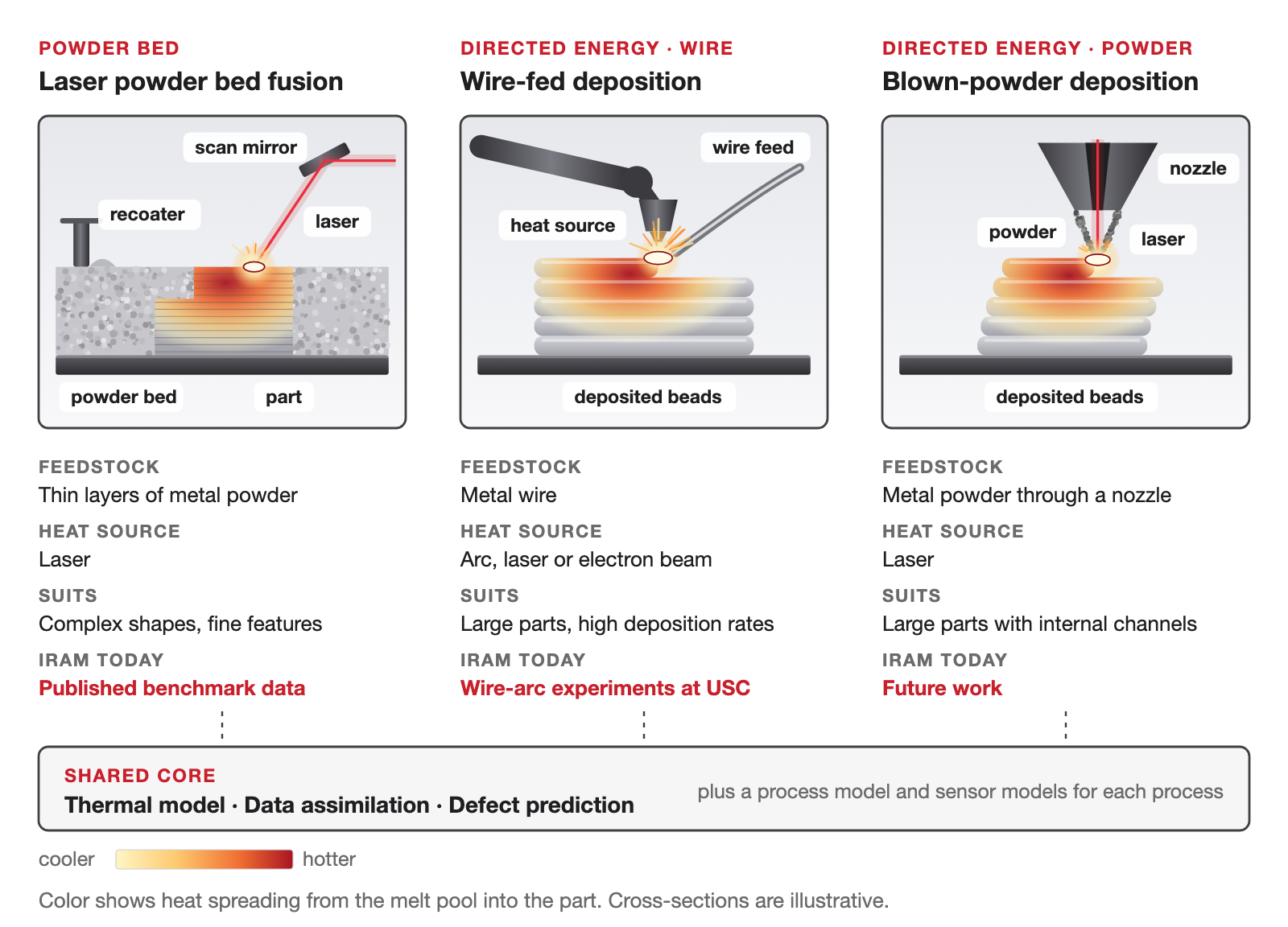
- Laser powder bed fusion. A laser melts a thin layer of metal powder one cross-section at a time. The process suits complex shapes and fine features, and NASA has used it for rocket engine components such as injectors and combustion chambers. The melt pool is small and fast, and the part is surrounded by powder, which shapes both the physics and what a camera can observe. IRAM’s work to date on this process uses published benchmark data.
- Wire-fed directed energy deposition. Metal wire is fed into a melt pool created by an electric arc, a laser, or an electron beam, usually on a robot or gantry. Deposition rates are high and parts can be large. NASA Langley’s Electron Beam Freeform Fabrication is a wire-fed process developed with in-space manufacturing in mind. IRAM’s experiments at the McNAIR Center use wire-arc additive manufacturing, a wire-fed process with an arc as the heat source.
- Blown-powder directed energy deposition. Metal powder is blown through a nozzle into a melt pool created by a laser. NASA’s Rapid Analysis and Manufacturing Propulsion Technology project has used it to build large rocket nozzles with integral cooling channels. For IRAM this process is future work.
IRAM is designed to support all three by separating what is shared from what is specific. The thermal model, data assimilation, and defect prediction form a common core. A process model describes how material and heat are delivered for one process, and a sensor model describes one sensor, as the next section explains. Moving to a new process or a new sensor means adding and validating a module, not rebuilding the framework.
In every case, each new machine and material needs its own calibration and validation before predictions can be relied on.
The Sensor Fusion Problem
Whichever process is running, the model sees the build only through its sensors. Combining them can sound like a matter of collecting more data. In this application it is the hardest part of the problem, for reasons that are specific to metal additive manufacturing:
- Sensors do not measure temperature directly. A thermal camera records emitted radiation. Converting that to temperature depends on emissivity, which changes with temperature, surface condition, and whether the metal is solid or liquid.
- The most important region is the hardest to see. The melt pool can exceed a camera’s measurement range, so readings are cut off exactly where the physics matters most. Those readings have to be treated as limits, not as measurements.
- The environment interferes. Arc glare, spatter, and the plume obscure the view, and the torch or the part itself can block the line of sight.
- Every data source has its own clock and coordinates. Cameras, thermocouples, and machine telemetry each record in their own time base and frame of reference. They must be aligned with the toolpath and with the model before they can be compared.
- Sensors see the surface; defects form inside. Agreement between model and measurement at the surface does not establish accuracy throughout the part.
- Different causes can produce the same signal. To a camera, more absorbed power and a larger heat source can look alike. Adding more sensors of the same kind does not separate them; experiments have to be designed so that each effect can be told apart.
- Ground truth arrives late and has limits of its own. Post-build inspection must be registered in space to the model, and it has its own resolution and detection limits.
IRAM’s approach is to fuse sensors through the physics. Each sensor is given an explicit measurement model, the sensor model in the framework above. It describes what that sensor would record for a given modeled temperature field, including its errors, its range, and its field of view. A build can combine several, and a new sensor type is added by writing and validating its measurement model. The lesson we take from this work is that the number of sensor types matters less than how well each one is calibrated, modeled, and aligned.
Why Julia?
Real-time digital twins require computational models that can keep pace with physical processes.
Julia provides high-performance numerical computing in a single programming language. Its open-source SciML ecosystem enables physics-based simulation, differentiable programming, and machine learning within a unified framework.
This allows Rallypoint One to integrate and extend existing scientific software into predictive models that can be evaluated against physical manufacturing data, without separating research models from their deployment implementations.
From Prediction to Real-Time Control
Predicting defects during manufacturing is the first step. The longer-term opportunity is to use those predictions to adjust the process before defects form.
In practice, “real time” is set by the process. A model-based decision has to be ready within the interval in which it can still be applied, such as the pause between passes or layers.
Rallypoint One is collaborating with Cognibotics, developer of Juliet & Romeo, a platform combining Julia-inspired robot programming with real-time execution.
Together, we are exploring how hybrid digital twins can interface with robotic control systems, connecting model predictions to manufacturing decisions.
This work reflects our broader focus on bringing physics-informed digital twins into direct interaction with physical systems across manufacturing, robotics, and aerospace.
Acknowledgments
Rallypoint One gratefully acknowledges NASA and the SBIR Ignite program, the University of South Carolina McNAIR Center, Cognibotics, and the researchers and developers advancing the open-source Julia ecosystem.
We look forward to sharing technical progress as IRAM advances.